
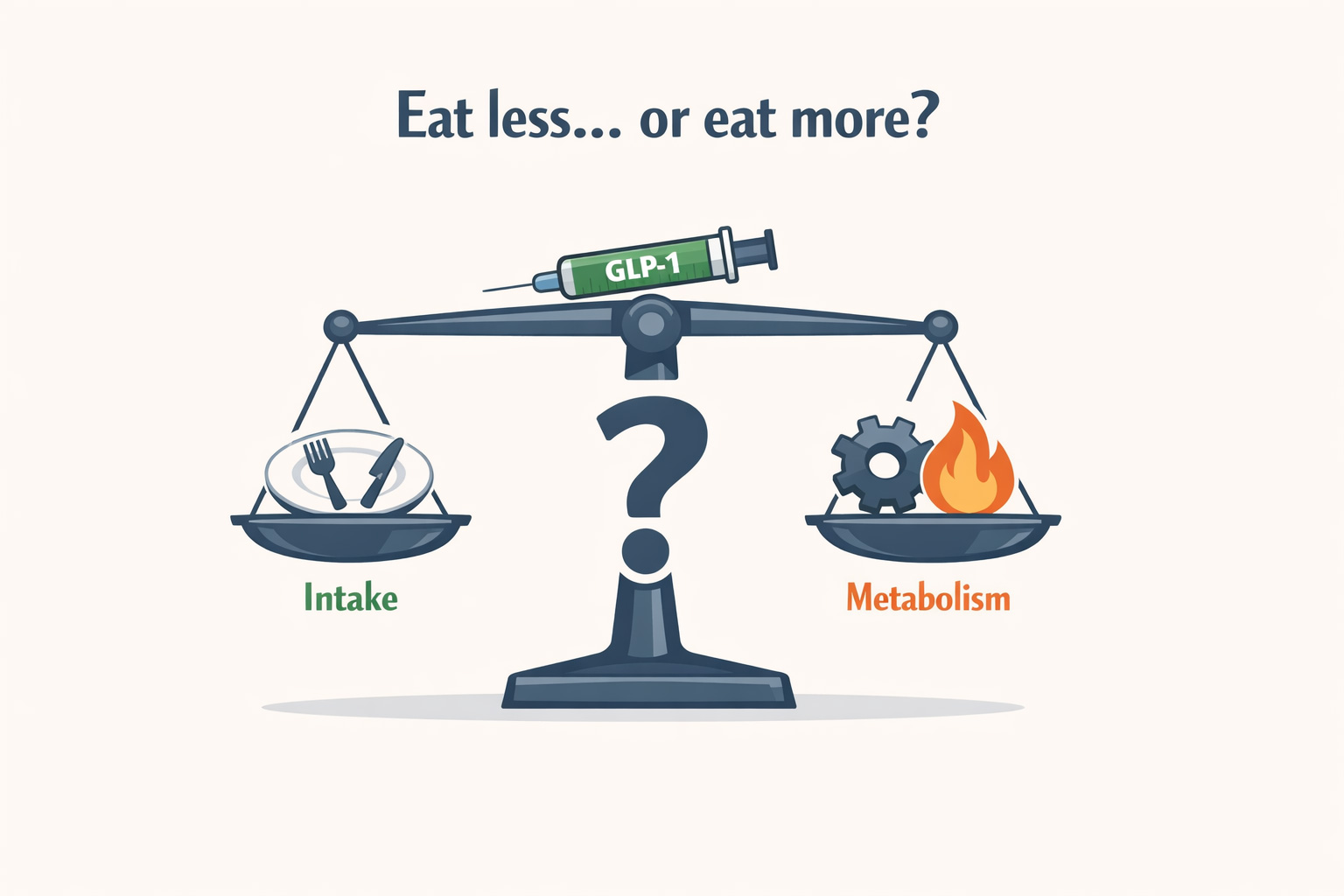
What lies behind the success of new weight loss medications? Metabolism or diet?
The success of incretin-based therapies for body weight reduction may be largely mediated by appetite suppression and the resulting reduction in caloric intake.
Author: Dr. Rocío Zamanillo Campos*
Registered Dietitian–Nutritionist (IB0102), PhD in Nutrigenomics and Personalized Nutrition, Postdoctoral Researcher at the Balearic Islands Health Research Institute (IdISBa), member of the Cochrane Balearic Islands group.
Reviewers: Escarlata Angullo Martínez, Maria José Barceló Picorelli, Maria Antonia Fiol de Roque*, and Ignacio Ricci Cabello*.
*Members of the Cochrane Balearic Islands group affiliated with Cochrane Iberoamerica.
In recent years, names such as “Ozempic” have jumped from medical offices to newspaper headlines and social media.
We are facing a family of drugs—GLP-1 receptor agonists—that promise to transform the treatment of obesity by biologically regulating our appetite. But are they really the “magic solution” they seem to be, or are we overlooking key pieces of the puzzle?
What are GLP-1 drugs and why do they generate so much interest?
These medications act by mimicking the effects of the hormone GLP-1, which regulates hunger and satiety signaling in the body. They are not new drugs, as they have been used for years to control blood glucose levels in people with type 2 diabetes. What is new is their widespread use with aesthetic goals and for body weight reduction, as they have recently been approved by regulatory agencies for the treatment of obesity.
In people with diabetes, these drugs are effective in controlling glycemia, preventing or slowing diabetic nephropathy, and reducing cardiovascular risk. In such cases, if tolerance allows good adherence, GLP-1 treatment is prescribed on a long-term basis. However, when used primarily for weight loss, the medication is withdrawn once the target weight is reached. Therefore, although their use in diabetes is well established and considered safe, the benefit–risk balance in individuals without major obesity or overweight-related comorbidities is still not fully clarified by the evidence available to date.
Currently, three medications are authorized by the Spanish Agency of Medicines and Medical Devices for the treatment of obesity: liraglutide (Saxenda, 2015), semaglutide (Wegovy, 2022), and tirzepatide (Mounjaro, 2022). The latter stands out as a dual agonist, meaning it acts not only on the GLP-1 receptor but also on the glucose-dependent insulinotropic polypeptide (GIP) receptor, offering superior efficacy in weight reduction compared with its predecessors.
Do they really work for weight loss? What the evidence says
Indeed, these medications produce clinically relevant weight loss while they are being taken. Results from one-year clinical trials show that they reduce body weight by approximately 4% with liraglutide, 11% with semaglutide, and up to 16% with tirzepatide.
However, it is important to note that most of these studies were conducted by the pharmaceutical industry, using placebo as the main comparator, without controlling dietary intake and without assessing what happens once the medication is discontinued. This strongly influences how the results should be interpreted.
The uncomfortable question: what happens when treatment is stopped?
Once the target weight is reached, treatment is discontinued, and the lost weight is regained faster and to a greater extent compared with lifestyle interventions. This is due to metabolic adaptations and compensatory mechanisms that “defend” body weight. After weight loss, the body increases hunger hormones (such as ghrelin) and cortisol, while reducing satiety hormones (including GLP-1, leptin, and PYY), thyroid hormones, and energy expenditure (by up to 28%).
These endocrine changes persist even one year after weight loss, making individuals highly vulnerable to weight regain.
Therefore, it is imperative that treatment guidelines address not only initiation and dose escalation, but also discontinuation and long-term maintenance strategies to sustain therapeutic achievements. In fact, the use of chronic micro-dosing with these and other drugs is beginning to be studied in order to maintain body weight in the long term.
Is it the drug that causes weight loss… or the drastic reduction in what we eat?
A critical aspect is how weight loss actually occurs. These drugs reduce caloric intake by 16% to 39%. This means that a person may go from consuming 2,000 calories per day to barely 800—essentially a hypocaloric diet.
This raises an ethical and clinical question: does the patient eat less because their metabolism has improved, or because they experience persistent discomfort and fullness that prevent them from eating?
The mechanisms of action of GLP-1 receptor agonists include appetite suppression and improvement of central and peripheral satiety signaling, leading to reduced caloric intake through actions at the level of the central nervous system; delayed gastric emptying, which prolongs the feeling of fullness after meals; and increased energy expenditure through thermogenesis.
With this in mind, it would be advisable to compare the effects of these medications with lifestyle interventions in terms of total daily caloric intake and physical activity level, or at least to adjust results for these two confounding factors, in order to assess the independent contribution of endogenous effects.
Thus, it remains unresolved what the outcomes of effectiveness studies would look like if they were adjusted for participants’ average dietary intake. We should also not forget that nutritional therapy should be present during treatment with GLP-1 analogues to ensure adequate nutritional status and prevent long-term consequences such as weight regain, osteoporosis, sarcopenia, and anemia.
The use of these drugs may partially displace the learning processes and professional support needed to sustain long-term lifestyle changes, replacing voluntary adherence to a hypocaloric diet with an involuntary reduction in intake associated with persistent feelings of fullness and discomfort.
What role do diet and lifestyle changes play?
According to clinical practice guidelines, the first-line treatment for obesity consists of offering an “integrated” lifestyle intervention. This includes counseling on behavioral changes related to diet (caloric restriction) and physical activity (150–250 minutes per week) for at least 6–12 months, and ideally for several years, under the supervision of dietitians-nutritionists. The specific type of diet is not as relevant, as none has proven to be more effective than others for weight loss. What matters is that the diet is balanced, healthy, hypocaloric, sustainable over time, and associated with high adherence.
Behavioral techniques include monitoring food intake and physical activity, controlling environmental food cues, goal setting, reinforcement and behavior shaping, problem solving, and social support. During active weight loss, the emphasis is usually on diet, whereas physical activity becomes central for weight-loss maintenance. Studies evaluating these interventions report weight loss ranging from 1% to 18% (around 8% on average), which is gradually regained when intervention intensity decreases or is discontinued, but without returning to baseline weight even after ten years.
Although lifestyle interventions achieve more modest weight-loss effects (5–10% of initial body weight) compared with semaglutide (11%) and tirzepatide (16%), two important aspects should be highlighted.
First, behavioral therapies for obesity management pursue goals beyond weight reduction alone, including risk reduction and health improvement. Obesity management cannot focus exclusively on weight (or BMI) reduction. Greater attention should be paid to waist circumference and improvements in body composition, with a focus on preserving or increasing fat-free mass and reducing fat mass.
The management of comorbidities (such as dysglycemia, hypertension, sleep apnea, psychological disorders), as well as improvements in quality of life and well-being, are also treatment goals in people living with obesity.
The second key aspect that remains insufficiently evaluated is the cost-effectiveness balance of chronic obesity treatments that include these drugs. It is striking that, in clinical practice, high-cost pharmacological treatments are often favored, while continued access to dietetic-nutritional intervention—which has been shown to be cost-effective—is not guaranteed.
The problem is not the drug, but the context in which it is prescribed
According to their official prescribing information, GLP-1 receptor analogues are indicated as an adjunct to a reduced-calorie diet and increased physical activity for weight management, including weight loss and weight-maintenance, in adults with a body mass index (BMI) of:
- ≥30 kg/m² (obesity), or
- ≥27 kg/m² to <30 kg/m² (overweight) in the presence of at least one weight-related comorbidity (e.g., dysglycemia, prediabetes or type 2 diabetes, hypertension, dyslipidemia, obstructive sleep apnea, or cardiovascular disease).
Two highly relevant aspects derive from this indication. First, the diagnosis of obesity or overweight varies with age and ethnicity/race, and should be accompanied by a thorough clinical and dietary history capable of identifying underlying disordered-eating patterns.
For example, postmenopausal women or women over 50 may have a BMI above 27 without truly meeting criteria for overweight. Individuals of Asian or African ancestry may not present with obesity based on BMI, yet have high body-fat percentages and poor glycemic control. A person with obesity may also present mental-health problems, binge-eating disorder, or constant grazing behaviors, which could compromise overall health if treated with these medications.
The second aspect is that these drugs must be prescribed as a complement to a low-calorie diet and increased physical activity within a structured program that includes both weight loss and weight-maintenance phases.
However, access to structured lifestyle-intervention programs remains limited in many healthcare systems, while pharmacological treatments are offered without ensuring maintenance of lost weight.
Prescribing these drugs in a social context that promotes unhealthy lifestyles addresses the problem through an individual solution, without correcting the social, commercial, and environmental causes that sustain obesity.
No drug can replace public-health policies, food education, and environments that make healthy living easier.
What we still need to know (looking ahead)
- Which mechanisms actually explain the observed weight loss?
- What role does dietary intake play in the results obtained?
- What should be done if weight is regained after discontinuation—or even exceeds baseline weight?
- Is it appropriate to prescribe these medications without specialized dietary and physical-activity counseling?
- How do they affect health beyond weight loss? Are they safe in the long term?
- Are these therapies cost-effective—and who bears the economic and social costs?
Editorial note
This text is a literal translation of the original article written in Spanish, available at the following link: https://evisap.es/que-hay-detras-del-exito-de-los-nuevos-medicamentos-para-adelgazar-metabolismo-o-dieta/.
The translation has been produced using artificial intelligence tools, with the aim of facilitating access to the content for an English-speaking audience.
All bibliographic references cited in this article correspond to the original Spanish version and can be consulted in full in that source.
